SEARCH

FIVE KEY CONCEPTS

While reading this peace, I found a few key concepts that challenged me:

Gordian knot, egalitarianism, clandestinely, Kremlinology, oligopolistic

GORDIAN KNOT DEFINITION

The origins of the “Gordian knot,” a term widely used to describe a complex or unsolvable problem, can be discovered back in a mythical chapter in the life of Alexander the Great. In regard to the chosen reading, Frank Pasquale talks about a Gordian knot of copyright conflicts in relation to Google system and search.

SUMMARY

In summary, the article is about the power of search. The author states, that Google is prejudiced, while company claims the opposite. It collects and organizes all sorts of world’s data and Google search makes a massive impact and influence over all users, although the majority of them don’t realize it. Google shows search results in a few moments; yet, users are provided with pages that Google wants people to see. The author believes, that all first slots of Google Search page are bought and usually they do not have any relevance to the user. It raises the problem; can user trust Google and it’s search results or user is just a part of money game? The author of my chosen reading reveals, that Google seems to block any kind of competition and it prioritizes web pages that pay money to be featured in the very beginning of the search results. Undoubtedly, it means that users are not being shown web search results in right order by relevance and importance to the user. Also, Frank Pasquale discussed other topics, for instance personalization, when user’s search results are customized based on the collected data about particular  person (web browser history, online purchases, etc.). It may influence some negative consequences. Pasquale described one situation as an example: if a person has psychological addiction to gambling, his or her search results will advertise more gambling related products and/or services, even more influencing this negative behavior.

REFLECTION

Frank Pasquale (2013) says “The power to include, exclude, and rank is the power to ensure which public impressions become permanent and which remain fleeting”. One of the examples of this quote is ‘Foundem’. It is a vertical search and price comparison web site, which was blocked by Google. The giant search engine stated that it was a very low quality web site, but, as author believes, it was blocked because Google desired to stay on the top and get rid of any kind of competitors. This action could mean that ‘Google’ company tries to be in control of users’ opinions. As soon as these problems were raised, the reaction was controversial; the purpose of blocking ‘Foundem’ website and other similar web sites was stated as better user experience. Google has done it repeatedly, which makes the author think that it is a simple game of disposing competitors in the market.

QUESTION

A question for the seminar discussion is: How it can affect Google services in the future?

BIBLIOGRAPHY

Pasquale, F. (2014). Chapter 3: ‘The Hidden Logics of Search’. ‘The Black Box Society: The Secret Algorithms that Control Money and Information.’

ALGORITHMS

SIX KEY CONCEPTS

While reading this peace, I found a few key concepts that challenged me:

Profiling identity, the eyes of the algorithm, build buzz, black box, targeted advertising, algorithmic imaginary

TARGETED ADVERTISING DEFINITION

Targeted advertising is a certain form of advertising which focuses on specific qualities, traits and characters of consumers and they are connected to a promoted product or service. These factors might be demographic (focusing on age, sex, economic status, etc.) or either they can be psychographic, which means the main focus goes on consumer’s values, character, lifestyle, hobbies, and outlook in general (Jansen, Moore & Carman, 2013). In addition, targeted advertising might be based on online behavior, for instance browsing history, purchase tendencies and other recent online actions.

SUMMARY

The author of the article explains how users of the Internet face algorithms on a daily basis. All the algorithmic calculations are based on user’s personal online history, in other words it is based on collected data from online actions. The phenomena called ‘algorithms’ are supposed to anticipate the activities of users, organizations and other mechanisms. Analytics turn big data into social data and, by building larger datastores have an ability to make particular predictions. To realize ways where users meet algorithms, this article suggests an idea of algorithmic imaginary. Also, it focuses on the real people experiences and understanding of the algorithm, and analyses how this makes them feel to understand its social power. Yet, the algorithmic system has created, as Bucher states, ‘a reason to react’ because of invasion into personal space of each user. For instance, Facebook users start to develop strategies to neutralize algorithms in diverse ways. Hill (2012) argues, that ‘resistance cannot merely be about opting out, but about participating in unpredictable ways’ (p.121). One of Bucher’s interlocutors states, that privacy online does not exist at all and he is eager to confuse algorithms because of private world invasion.

REFLECTION

 “Better-targeted ads produce economic benefits” believes Taina Bucher. Certain kind of businesses or campaigns are based on promoting and selling services to people, who have experienced certain major life events. For instance, funeral services want to make connections with users who want to plan a funeral or they have critically ill relative or friend. Moving services want to get connections with people, who recently bought a new house or flat. The same principles apply to wedding organization services and many others. People tend to share their important life events with their friends on Facebook and Facebook, being one of the most powerful social media platforms, has a conceivable life event targeting option. The Life Events parameter is exclusive in terms of targeting people because promoter has an option to choose specific intervals of showing ads. For example, a jewelry company would be interested in getting in touch with people who want to celebrate their one-year anniversary. By using The Life Events parameter, they have an option to target users who got married one year ago.

QUESTION

If to consider the future of algorithmic system, how will the ways, in which people understand algorithmic actions, affect the logic of whole system?

BIBLIOGRAPHY

Taina Bucher (2016). The algorithmic imaginary: exploring the ordinary affects of Facebook algorithms, Information, Communication & Society, DOI: 10.1080/1369118X.2016.1154086

Jansen, B. J., Moore, K., & Carman, S. (2013). Evaluating the performance of demographic targeting using gender in sponsored search. Information Processing and Management, 49(1)


BIG DATA

FIVE KEY CONCEPTS

big data, datafication, orthodoxy, metadata, structured data

DEFINITION

‘Big data is a new oil’, says Ann Winblad, investor and senior partner at Hummer-Winblad. According to OED, big data is ‘extremely large data sets that may be analysed to reveal trends and associations relating to human behaviour and interactions’. In other words, with information explosion scientists are able to harness information in novel ways to produce useful insights and services of significant value (Gil Press, 2014). A great example of how big data is being used to push sales is electronic commerce company Amazon. Amazon users get daily suggestions what to buy, based on information of their past purchases. In this way, company gets data and reveals the best deals and offers for a particular customer.

SUMMARY

The era of big data starts a major technology world transformation. The amount of data stored in the world increases four times faster than the world economy. The change will challenge the way people live and interact with the rest of the world. Therefore, society needs to face new global concept of understanding surrounding objects and actions – not knowing why but only what. According to Forrester, ‘All companies are data businesses now’, which means companies attempt to collect valuable data and turn it into revenue. They collect data from various sectors, such as medicine, financial institutions, social networks, etc. and reinterpret that information into usable sets. Also, the storage costs of big data has dropped significantly and it makes it easier to save information instead of discarding it.

REFLECTION

The future of Big Data is about predictions. In fact, the revolution is not in the machines that collect and calculate information but in information itself and in the way how humans use it (Cukier, K.2013). Being a completely new form of economic value, big data is supposed to be reused and become the main source of future innovations. In the near future, many aspects of human lives will be computerised and fed with important data, which will lead to making predictions: diagnosing illnesses, picking treatments or identifying criminals before they commit a crime. For today, big data has already made some minor but important changes in our society. Instagram, online photo-sharing and social-networking service, has just launched their newest feature. It allows to anonymously flag a certain post that seems to be concerning or the content uploader seems to need support for mental health. The social media platform will also offer numbers for support helplines and information on how to seek for an advice for mental issues when anyone tries to search for hashtags like ‘selfharm’. Also, Instagram has banned hashtags like ‘thigh gap’, ‘thinspiration’ to combat anorexia issue in the world. All these changes are based on data collected from active users, Instagram’s search queries and other important information.

QUESTION

However, the quality and the accuracy of data is questionable; and how undertakings use it might affect an individual in decisions that are made. How accurate is personal information acquired from social media?

BIBLIOGRAPHY

Cukier, K., & Mayer-Schonberger, V. (2013). Big Data: A Revolution That Will Transform How We Live, Work and Think.

Press, G. (2014) 12 Big Data Definitions What’s Yours? Forbes. Available at: http://www.forbes.com/sites/gilpress/2014/09/03/12-big-data-definitions-whats-yours/ (Accessed: 18/10/16)

Hopkins, B. (2016) Predictions 2016: The Path From Data To Action For Marketers. Forrester.


Gender roles in advertising


This blog post will concentrate on sexist ideas, which appear in advertising. The gender stereotype is known since immemorial times: men are supposed to earn money while women are considered as an instrument of sexual pleasure. Society tries to combat this stereotype, yet the advertising industry does not cooperate. The given examples will evidence gender stereotype and sexual objectification of women in particular.

Gender stereotypes in particular, are defined as beliefs that certain attributes differentiate women and men (Ashmore and Del Boca 1981). It is believed that the purpose of female gender is to be attractive visually and to satisfy needs of the opposite gender. In other words, as John Berger claims (1990), women watch themselves being looked at and this determines not only most relations between men and women but also the relation of women to themselves. Thus she turns herself into an object – and most particularly an object of vision: a sight.

Image one(bdf9b5069710867ea4a83f7fe65320bd.jpg)

ibexn

The first example is a print advertisement for Drummond sweaters published in late 1960s. Those times are famous for inappropriate advertisements and this example is not an exception. It is an image of nude woman whose intimate parts of body are covered with masculine sweaters sleeves. Her seductive pose makes her look very sexual. The words on the bottom of the image reads ‘If you guys don’t buy these new Drummond sweaters, we’ll go right back to male models.’ In this picture woman is depicted as sex object; her main purpose is to be a decoration and to sell the product.

Image two(ck3-png.png)

Another sexist example is recently launched #MyCalvins campaign by Calvin Klein. The main concept of the campaign is to demonstrate how famous people such as Justin Bieber, Kendall Jenner and etc spend their time wearing Calvin Klein underwear. This advertising campaign has been quite successful on social media. Yet, some people believe that the billboard advertisement, which is in New York City, is extremely sexist and what is more important it is offensive to women. The advertisement contains of two images. The first one is a picture of actress Klara Kristin posing seductively in white transparent dress with the caption ‘I seduce in #mycalvins’. The second is a portrait of rapper Fetty Wap with the words ‘I make money in #mycalvins’. The denotation of this advert is quite clear, it demonstrates that females are sexual objects, while males are considered as breadwinners.

To sum up, nowadays there are a lot of organisations, which try to fight with, quite obvious sexist ideas in published advertisements; as long as those ideas are public, stereotypes will remain in society. Unfortunately, people tend to think that this situation is better nowadays than in the past. Yet, commercials, music videos, and even the prevalence of pornography in the American consciousness as well as the global market, clearly show that the world is not a progressively improved place.

Bibliography:

Berger, J. (2008). Ways of seeing (Vol. 1). Penguin UK.

Ashmore, R. D., & Del Boca, F. K. (1981). Conceptual approaches to stereotypes and stereotyping. Cognitive processes in stereotyping and intergroup behavior1, 35.

Zimmerman, A., & Dahlberg, J. (2008). The sexual objectification of women in advertising: A contemporary cultural perspective. Journal of advertising research48(1), 71-79.


Racism in advertising

This blog post will overlook two examples of racist advertising: one of them is an advertisement from 1970s and another is a contemporary advert. The aim of this work is to examine how racial stereotype was accepted 40 years ago and how it is rejected in the meantime.

Image one(enhanced-buzz-28969-1340721616-0.jpg)

article-2165398-13d027c6000005dc-963_636x868


The first example is one of the many advertisements of 70s, which have racial undertones. This advertisement depicts a happy African-American family gathered around the table at the fast food restaurant. The ad also claims ‘You don’t have to be dressed up’ and ‘There’s no tipping’. By analyzing this advert in connotational way it becomes quite clear that it has some racism related propositions. The hidden message is that black Americans were incapable to afford dining in a restaurant at a time, which means that black Americans were considered as less wealthy people. It also plays on a working-class stereotype (Nick Enoch, 2012). It is not race that matters directly; instead, what matters are the wealth levels and class positions that are associated with race in America (Dalton Conley, 1999). Unfortunately, this racist issue was ignored in 1976 and the campaign successfully remained public for a couple of years and helped to grow McDonalds as a brand.

Image two(gapkids-hed-2016.jpg)

57027bb21e000087007061d1

On the other hand there is a contemporary advertisement which was published in April 2016. Globally famous brand Gap collaborated with Ellen Degeneres’s brand ED and made campaign called ‘Le PeTiT CiRqUe’, which was posted on GapKids Twitter feed. The four girls, pictured in the given image, are part of cirque troupe. While two side girls show their acrobatic skills, the girls in the middle, white and black, stand still. The global debate focused on white girl’s gesture – she uses black girl’s head as an armrest. The major number of viewers pointed it out as passive racism. According to critics, it is a shame to have only one black model in this kind campaign. Also, Ellen DeGeneres interviewed those girls and the black girl was the only one who didn’t speak at all.

The interview: https://www.youtube.com/watch?v=gdxXBqdfWME

The main difference between these two examples is that passive racism in 70s was completely ignored. Yet, after a massive attack on Twitter, GapKids apologized for any offence caused and said the company will remove the image in question from the campaign. The immediate reaction of company proves that nowadays society tries to avoid any kind of inconvenience for minorities caused by offensive advertisements.

In conclusion, the racial stereotype has evolved over the pas few decades. Racist propositions, which were considered as natural in 1970s, nowadays are extremely inappropriate. Society tries to eliminate this old and incorrect stereotype. Also, Gap kids campaign’s photo and video is a reminder of how easily advertisement imagery can be met with negative interpretations (2016).

Bibliography:

Conley, D. (1999). Being black, living in the red: Race, wealth, and social policy in America. Univ of California Press.

Enoch, N. (2012)’You Don’t Have To Get Dressed Up… And There’s No Tipping’: Mcdonald’s Ad From 1976 Tries To Target Black Customers”. Mail Online. N.p., 2012. Web. 21 Apr. 2016.

“Gap Has Apologized For This Gapkids Ad, But Did It Need To?”. AdWeek. N.p., 2016. Web. 21 Apr. 2016.


BEAUTY STANDARDS in ADVERTISING

This blog post is dedicated to female body image stereotype and how it reflects in advertising. The given examples will represent what kind of females bodies were believed to be ‘beautiful’ back in 1940s and how female body image stereotype has rapidly changed in less than one hundred years.

To begin with, advertising is a form of communication intended to persuade an audience to buy products, ideals or services. While advertising can be seen as necessary for economic growth, it is not without social costs (Dan Padgett, 1997). Not unexpectedly, advertisements dictate how individuals should behave, what kind of lifestyle they should choose and, most importantly, adverts illustrate how people should look like. According to study, conducted by Hovard Lavine (1999), women exposed to sexist adverts judged their current body sizes as larger and revealed a larger discrepancy between their actual and ideal body sizes (preferring a thinner body).

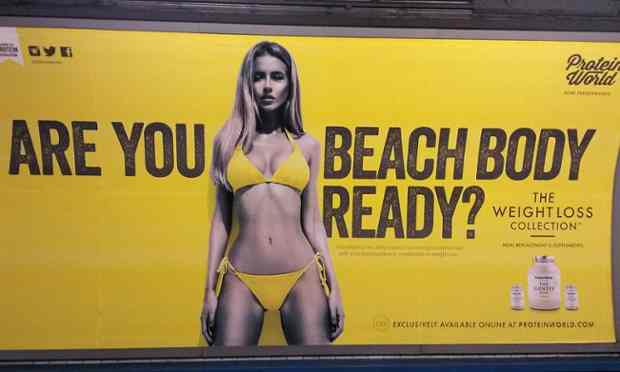
Image one (45775830-2510-465f-a8cb-bda9b5a82951-620×372.jpeg)45775830-2510-465f-a8cb-bda9b5a82951-620x372

The advertisement I would like to talk about has caused a lot of discussions and debates. It is a print advert for Protein World – food supplements that fight with extra weight. In the center of the image there is a model wearing a bright yellow bikini. The girl has a quite skinny body and the advertisement reads ‘Are you beach body ready?’ Target audience is women of all ages who are not confident with their bodies. The advertisement makes an average woman question herself ‘Do I look like the girl in the picture? This kind of advertising creates new apotheosis and is a causer of major psychological issues in women minds. It is the main reason why this controversial ad campaign has received more than 360 complains and has been banned due to the concerns over weight loss claims (Mark Sweney, 2016).

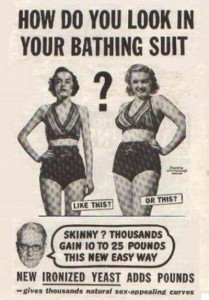
Image two (tumblr_m5o4udatpi1ru3pbjo1_400.jpg)

1920-209x300

However, in older adverts the woman body image stereotype motives  are completely different. If we take a look at example two – ironized yeasts advertisement published in early 1940s, we see two women (they have different body sizes) and the question mark between them. The caption says ‘How do you look in your bathing suit’ letting viewers (female gender in particular) to pick which body image is more comparable to their bodies. Beneath them there is a head of a man (assumable he is a medic; his glasses suggest it), which says ‘Skinny? Thousands gain 10 to 25 pounds this new easy way’. This advert glorifies curvy body forms and claims that ‘sex-appealing’ curves are beauty standard.

To sum up, this blog post revealed two different sides of female body image ideology. Nowadays advertising industry pushes the idea that beautiful woman is skinny woman. It is a huge issue and this stereotype is the main causer of low-esteem of female gender. On the other hand, more than seventy years ago woman with curvy body shape was considered as beauty standard. This idea humiliated skinny females and lowered their self-esteem too. Neither of these statements is correct; there is no definition of ‘beauty’ and there is no answer which body type is supposed to be ‘beautiful’.

Bibliography:

Lavine, H., Sweeney, D., & Wagner, S. H. (1999). Depicting women as sex objects in television advertising: Effects on body dissatisfaction. Personality and Social Psychology Bulletin, 25(8), 1049-1058.

Padgett, D., & Allen, D. (1997). Communicating experiences: A narrative approach to creating service brand image. Journal of advertising, 26(4), 49-62.

Sweney, M., (2016) “‘Beach Body Ready’ Ad Banned From Returning To Tube, Watchdog Rules”. the Guardian. N.p., 2015.